

All articles
AI Search Optimization: How to Get Recommended by ChatGPT, Perplexity, and AI Overviews

/* ============ SHARED BASE ============ */
.crpr-blog,
.crpr-blog *,
.crpr-blog *::before,
.crpr-blog *::after{ box-sizing:border-box; }
.crpr-blog{ width:100%; font-family:inherit; -webkit-font-smoothing:antialiased; }
.fl-module-html .fl-module-content:has(.crpr-blog){ margin:0 !important; }
.crpr-wrap{
position:relative;
width:100%;
max-width:1180px;
margin:0 auto;
padding-left:24px;
padding-right:24px;
}
.crpr-accent{ color:#1FA97A; }
/* ===================== POST HERO ===================== */
.crpr-post-hero{
position:relative;
overflow:hidden;
padding:clamp(30px,4vw,54px) 0 clamp(26px,3.5vw,42px);
background:#F7FAF8;
}
.crpr-post-hero::before{
content:””;
position:absolute;
top:-190px; right:-130px;
width:430px; height:430px;
border-radius:50%;
background:radial-gradient(circle,rgba(112,250,188,.24) 0%,rgba(112,250,188,0) 70%);
pointer-events:none;
}
/* Everything in the hero sits on a narrower measure than the grid */
.crpr-post-hero .crpr-wrap{ max-width:820px; }
/* ———- Back link ———- */
.crpr-back{
display:inline-flex;
align-items:center;
gap:7px;
margin:0 0 22px;
color:#54646E !important;
font-size:13.5px;
font-weight:600;
text-decoration:none !important;
transition:color .18s ease;
}
.crpr-back svg{ width:15px; height:15px; flex:0 0 auto; transition:transform .18s ease; }
.crpr-back:hover{ color:#0B1F3A !important; }
.crpr-back:hover svg{ transform:translateX(-3px); }
.crpr-back:focus-visible{ outline:2px solid #0B1F3A; outline-offset:3px; border-radius:3px; }
/* ———- Category chips ———- */
.crpr-post-cats{
display:flex;
flex-wrap:wrap;
gap:7px;
margin:0 0 16px;
}
.crpr-post-cats a{
display:inline-block;
padding:5px 12px;
border:1px solid rgba(11,31,58,.10);
border-radius:999px;
background:#fff;
color:#1FA97A !important;
font-size:11.5px;
font-weight:700;
letter-spacing:.02em;
line-height:1.4;
text-decoration:none !important;
transition:border-color .18s ease, background .18s ease;
}
.crpr-post-cats a:hover{ border-color:#70FABC; background:#EEFCF5; }
/* ———- Title ———- */
.crpr-post-title{
margin:0 0 16px !important;
color:#0B1F3A !important;
font-size:clamp(27px,4vw,45px) !important;
font-weight:800 !important;
line-height:1.12 !important;
letter-spacing:-.025em;
}
/* ———- Meta ———- */
.crpr-post-meta{
display:flex;
flex-wrap:wrap;
align-items:center;
gap:2px;
color:#6B7B85;
font-size:13.5px;
font-weight:600;
line-height:1.5;
}
.crpr-post-meta a{ color:#1FA97A !important; text-decoration:none !important; }
.crpr-post-meta a:hover{ text-decoration:underline !important; }
.crpr-meta-sep{ margin:0 8px; color:rgba(11,31,58,.25); }
/* ———- Featured image ———- */
.crpr-post-figure{
margin:clamp(26px,3.5vw,40px) 0 0 !important;
padding:0 !important;
overflow:hidden;
border:1px solid rgba(11,31,58,.08);
border-radius:16px;
background:#0B1F3A;
aspect-ratio:16 / 9;
box-shadow:0 8px 28px rgba(11,31,58,.08);
}
.crpr-post-figure img{
width:100% !important;
height:100% !important;
max-width:none !important;
display:block;
object-fit:cover;
border-radius:0 !important;
}
@media (max-width:767px){
.crpr-wrap{ padding-left:20px; padding-right:20px; }
.crpr-post-figure{ border-radius:13px; aspect-ratio:4 / 3; }
.crpr-back{ margin-bottom:18px; }
}
/* ============================================================
POST BODY TYPOGRAPHY
Give the ROW holding your Content module the class:
crpr-post-body (Advanced tab → Class)
============================================================ */
.crpr-post-body{
background:#F7FAF8;
padding-top:clamp(28px,3.5vw,44px) !important;
padding-bottom:clamp(36px,4.5vw,60px) !important;
}
.crpr-post-body .fl-row-content{
max-width:820px !important;
margin:0 auto;
}
.crpr-post-body .fl-rich-text,
.crpr-post-body .fl-module-content{
color:#3E4E58;
font-size:17px;
line-height:1.78;
}
.crpr-post-body p{
margin:0 0 22px;
color:#3E4E58;
font-size:17px;
line-height:1.78;
}
.crpr-post-body h2{
margin:42px 0 14px;
color:#0B1F3A;
font-size:clamp(22px,2.6vw,29px);
font-weight:800;
line-height:1.25;
letter-spacing:-.02em;
}
.crpr-post-body h3{
margin:32px 0 12px;
color:#0B1F3A;
font-size:clamp(18px,2vw,22px);
font-weight:700;
line-height:1.3;
}
.crpr-post-body h4{
margin:26px 0 10px;
color:#0B1F3A;
font-size:17px;
font-weight:700;
}
.crpr-post-body a{
color:#1FA97A;
text-decoration:none;
border-bottom:1px solid rgba(31,169,122,.35);
transition:border-color .18s ease;
}
.crpr-post-body a:hover{ border-bottom-color:#1FA97A; }
.crpr-post-body ul,
.crpr-post-body ol{
margin:0 0 22px;
padding-left:22px;
}
.crpr-post-body li{
margin:0 0 9px;
color:#3E4E58;
font-size:17px;
line-height:1.72;
}
.crpr-post-body li::marker{ color:#1FA97A; }
.crpr-post-body blockquote{
margin:30px 0;
padding:20px 24px;
border:0;
border-left:3px solid #70FABC;
border-radius:0 12px 12px 0;
background:#fff;
color:#0B1F3A;
font-size:18px;
font-style:normal;
line-height:1.65;
}
.crpr-post-body blockquote p:last-child{ margin-bottom:0; }
.crpr-post-body img{
max-width:100%;
height:auto;
border-radius:12px;
}
.crpr-post-body figcaption{
margin-top:9px;
color:#6B7B85;
font-size:13px;
text-align:center;
}
.crpr-post-body hr{
margin:36px 0;
border:0;
border-top:1px solid rgba(11,31,58,.10);
}
.crpr-post-body table{
width:100%;
margin:0 0 24px;
border-collapse:collapse;
font-size:15px;
}
.crpr-post-body th,
.crpr-post-body td{
padding:11px 14px;
border:1px solid rgba(11,31,58,.10);
text-align:left;
}
.crpr-post-body th{ background:#fff; color:#0B1F3A; font-weight:700; }
@media (max-width:767px){
.crpr-post-body p,
.crpr-post-body li{ font-size:16px; }
.crpr-post-body blockquote{ font-size:16.5px; padding:17px 19px; }
}
@media (prefers-reduced-motion:reduce){
.crpr-back svg{ transition:none; }
.crpr-back:hover svg{ transform:none; }
}
/* Credible PR article tables */
.crpr-article-content table,
.fl-module-rich-text table {
width: 100%;
border-collapse: separate;
border-spacing: 0;
border: 1px solid #D9D9D9;
border-radius: 16px;
overflow: hidden;
background: #fff;
margin: 30px 0;
}
.crpr-article-content th,
.crpr-article-content td,
.fl-module-rich-text th,
.fl-module-rich-text td {
padding: 18px 20px;
border-right: 1px solid #D9D9D9;
border-bottom: 1px solid #D9D9D9;
text-align: left;
vertical-align: top;
line-height: 1.6;
}
.crpr-article-content th,
.fl-module-rich-text th {
font-weight: 600;
background: #F7F7F7;
}
.crpr-article-content th:last-child,
.crpr-article-content td:last-child,
.fl-module-rich-text th:last-child,
.fl-module-rich-text td:last-child {
border-right: 0;
}
.crpr-article-content tr:last-child td,
.fl-module-rich-text tr:last-child td {
border-bottom: 0;
}
/* Mobile */
@media (max-width: 768px) {
.crpr-article-content table,
.fl-module-rich-text table {
display: block;
overflow-x: auto;
white-space: normal;
}
}
Quick answer: AI Search Optimization is the practice of structuring a business’s online presence — entity authority, structured data, and clearly written content — so AI systems like ChatGPT, Perplexity, and Google’s AI Overviews can confidently find, trust, and cite it when generating answers. It builds on traditional SEO rather than replacing it, and the businesses winning at it are the ones being mentioned consistently and clearly across the web, not just ranking on page one.
Search used to end with a list of links. Increasingly, it ends with an answer — generated, synthesized, and delivered before anyone clicks anything. If a business isn’t part of what the AI pulled together to write that answer, it’s effectively invisible at the exact moment someone was ready to choose.
That’s the problem AI Search Optimization solves. This guide covers how AI engines actually generate those answers, what determines whether a business gets mentioned, and the concrete steps that move the needle — for tech companies, healthcare practices, professional services, and local businesses alike.
What AI Search Optimization Actually Is
AI Search Optimization is the work of making a business easy for AI systems to find, understand, and cite confidently. You’ll also see it called Generative Engine Optimization (GEO), Answer Engine Optimization (AEO), or AI Optimization (AIO) — the terminology is still settling, and different platforms use different terms for largely the same discipline. Google’s own 2026 guidance on optimizing for generative AI features frames it plainly: optimizing for AI search is still, fundamentally, optimizing for search — it’s an extension of SEO, not a separate discipline built from scratch.
What’s genuinely different is the target. Traditional SEO optimizes a page to rank. AI Search Optimization optimizes information to be extracted, trusted, and attributed — sometimes from a page that never ranks in the top 10 at all.
How AI Engines Actually Generate Answers
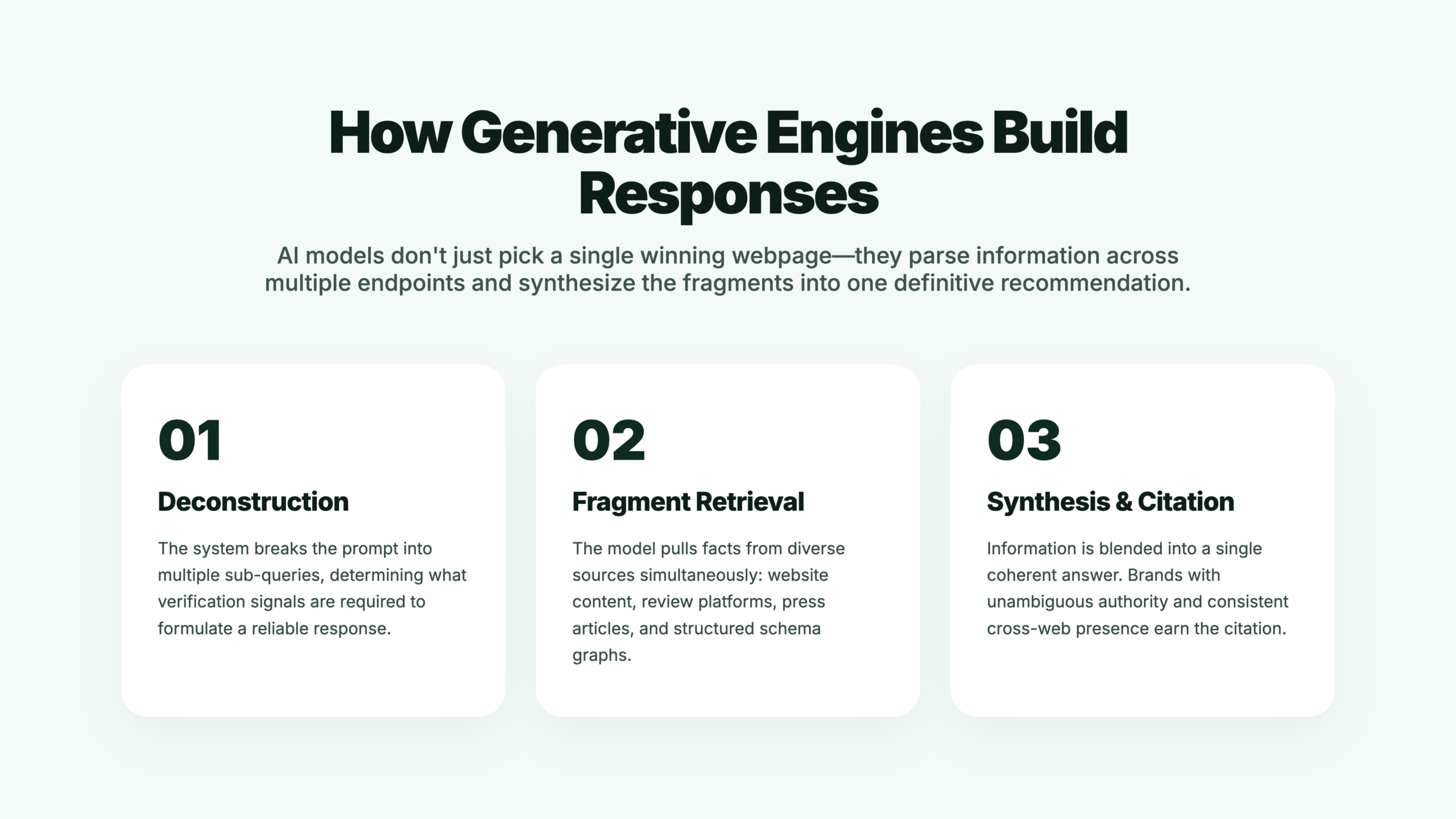
Understanding this changes how you optimize. When someone asks an AI assistant a question, the system typically doesn’t run one search — it breaks the question into several sub-questions, gathers relevant fragments from multiple sources, and synthesizes them into a single response. Ask an AI “who’s a trusted [service] in [city],” and it may be quietly checking review sentiment, credentials, recent press coverage, and site content — from several different sources — before writing one answer.
This is why a single well-optimized landing page isn’t enough. The business needs to be found consistently across the fragments an AI engine is likely to pull from: its own site, review platforms, press coverage, and any third-party content that mentions it.
AI Search Optimization vs. Traditional SEO
| Traditional SEO | AI Search Optimization | |
|---|---|---|
| Goal | Rank a page in search results | Get cited, quoted, or recommended in a generated answer |
| Unit of success | Page ranking position | Whether the brand is mentioned at all, and how favorably |
| What matters most | Keywords, backlinks, on-page structure | Entity clarity, structured data, consistency across sources, direct-answer content |
| Where it’s measured | Search Console, rank trackers | Prompting AI tools directly, citation tracking |
The two aren’t competing disciplines. Good SEO fundamentals — quality content, real backlinks, technical health — remain the foundation AI Search Optimization is built on top of. It adds a layer specifically aimed at how generative systems extract and attribute information, rather than how they rank it.

What Actually Signals Trust to AI Systems
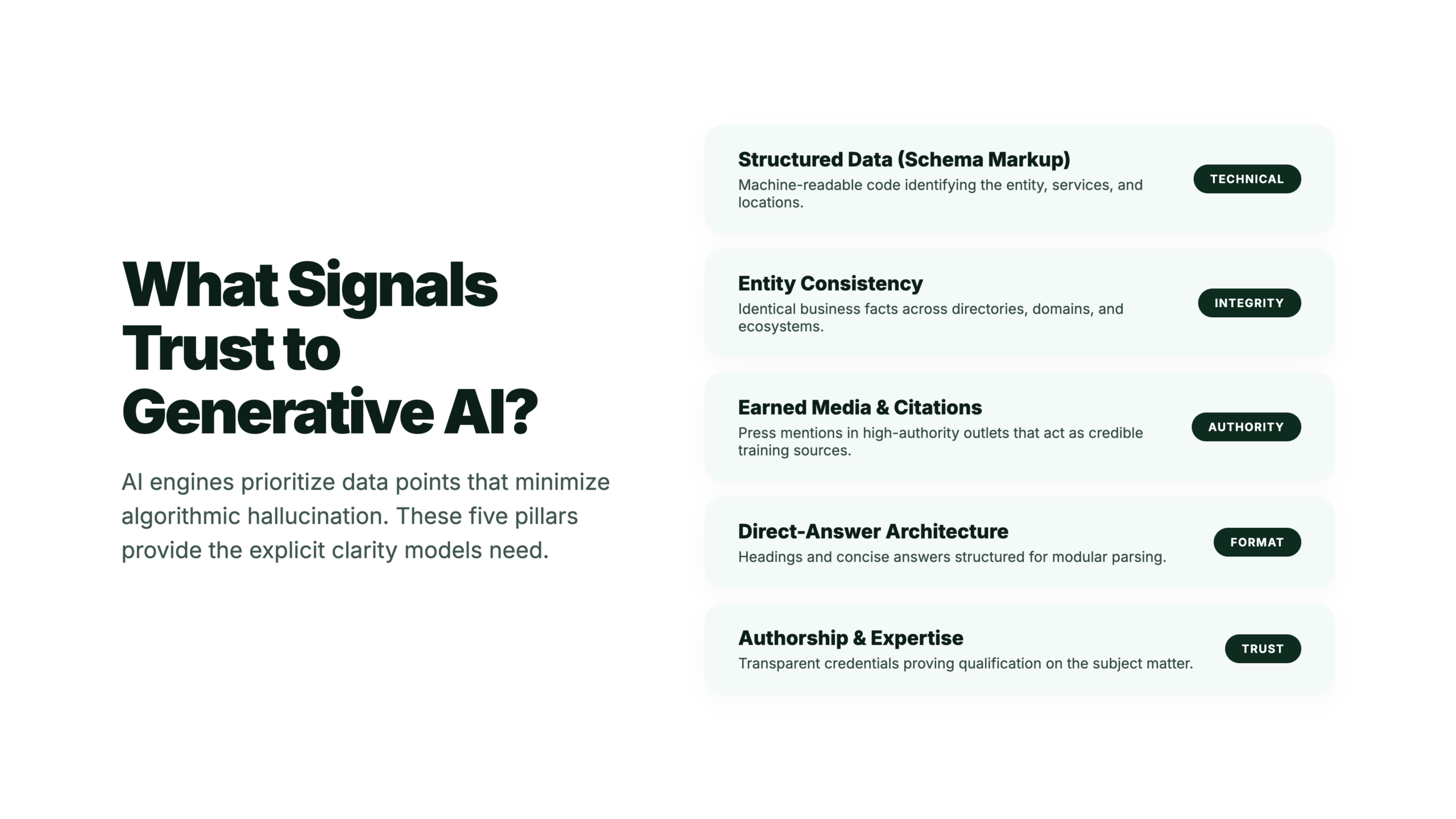
- Structured data (schema markup). Explicit, machine-readable markup that states what a business does, where it operates, and what it’s known for — removing ambiguity for a system that has to make a fast judgment call.
- Entity consistency. The same business name, services, and details need to appear consistently across the web. Conflicting information across a website, directories, and review platforms makes it harder for an AI system to form a confident answer.
- Earned mentions and citations. Coverage in recognized publications functions as a trust signal AI systems weigh heavily — the same earned-media logic that applies to traditional PR applies here, arguably even more directly, since AI systems are explicitly built to identify credible sources.
- Direct-answer content structure. Clear definitions, well-organized headings, and content that answers a specific question plainly are easier for an AI system to extract cleanly than dense, marketing-heavy copy.
- Authorship and expertise signals. Clear information about who wrote something and what qualifies them to speak on it strengthens how AI systems weigh a source’s credibility.
Practical Steps to Start Optimizing for AI Search
- Audit what AI currently says about the business. Ask ChatGPT, Perplexity, and Google directly — “who is [business],” “best [service] in [location].” The gaps in what comes back show exactly where the work needs to start.
- Add or clean up schema markup for the organization, services, and location, so the business’s core facts are stated explicitly rather than implied.
- Fix inconsistent business information across the website, directories, and review platforms — name, services, and location should match everywhere.
- Publish content in a direct-answer format — clear definitions, structured headings, and FAQs — rather than long, unstructured marketing copy.
- Earn mentions in credible, recognized sources. This is where PR and AI Search Optimization overlap directly: a placement that builds trust with a human reader also becomes a citation an AI system can reference.
- Re-check the AI answers periodically. This isn’t a one-time fix — AI systems update what they retrieve from as new content and signals appear.
How Long It Actually Takes
Results build in layers. Technical changes — schema markup and structured data — can influence how live-retrieval engines like Perplexity or Google’s AI Mode represent a business within roughly 2 to 4 weeks. Broader entity authority — built through consistent mentions, earned coverage, and accumulated trust signals — takes longer and builds progressively with continued work, similar to how organic SEO authority compounds over months rather than appearing overnight.
Key Takeaways
- AI Search Optimization builds on SEO — it doesn’t replace it. Strong content, real backlinks, and technical health remain the foundation.
- AI engines synthesize answers from multiple fragments, not a single ranked page, so consistency across sources matters more than any one page being perfect.
- Structured data and entity consistency are the technical foundation; earned media and direct-answer content are what actually get cited.
- PR and AI Search Optimization overlap directly — a credible press mention is also a citation source for AI-generated answers.
- Schema and technical changes can influence AI retrieval within weeks; broader authority-building takes longer and compounds over time.
- This isn’t a one-time project. Checking what AI systems currently say about a business, and adjusting, needs to happen on an ongoing basis.
FAQs
Online reputation isn’t built by one review or one article — it’s the accumulation of what’s said about a business, where, and how recently. The fastest, most durable way to strengthen it is earning credible media coverage and making sure that credibility is properly represented in search and AI search — because those two efforts reinforce each other automatically.
How Credible PR Can Help
AI Search Optimization is a core part of how Credible PR builds visibility:
- AI Search Optimization — entity authority, structured data, and content engineered specifically for AI retrieval, so a brand shows up when prospects ask AI for recommendations.
- Top-Tier Media Placements — guaranteed features in Forbes or USA Today within 30 days, which double as citation-worthy sources AI systems can reference.
- Podcast Placements — guest appearances on established podcasts, another growing source of credible, citable mentions AI systems draw on.
Because media placements, AI search optimization, and podcast PR all run through one strategy, the credibility signals reinforce each other instead of existing in isolation. See how it works.

The 30-Day Guarantee
Reading about it is one thing. Ranking is another.
Book a free strategy call and we’ll map out exactly where your brand is invisible —
across search, AI assistants, Maps, and media — and what it takes to fix it.
- Featured in Forbes or USA Today within 30 days — or we keep working at no extra cost.
- One partner for PR, AI search, Maps, and ads instead of four separate vendors.
- Market exclusivity: one practice per market, so competitors can’t hire us.
/* —- shared base (safe to repeat) —- */
.crpr-blog,
.crpr-blog *,
.crpr-blog *::before,
.crpr-blog *::after{ box-sizing:border-box; }
.crpr-blog{ width:100%; }
.crpr-wrap{
position:relative;
width:100%;
max-width:1180px;
margin:0 auto;
padding-left:24px;
padding-right:24px;
}
.crpr-narrow{ max-width:820px; }
.crpr-post-end{
padding:0 0 clamp(44px,5.5vw,70px);
background:#F7FAF8;
}
/* ===================== AUTHOR BOX ===================== */
.crpr-author{
display:flex;
align-items:flex-start;
gap:18px;
padding:22px;
border:1px solid rgba(11,31,58,.08);
border-radius:14px;
background:#fff;
box-shadow:0 2px 12px rgba(11,31,58,.05);
}
.crpr-author-avatar{
flex:0 0 auto;
width:56px;
height:56px;
overflow:hidden;
border-radius:50%;
background:#EEFCF5;
}
.crpr-author-avatar img{
width:100% !important;
height:100% !important;
display:block;
object-fit:cover;
border-radius:50% !important;
}
.crpr-author-label{
margin:0 0 3px !important;
color:#1FA97A !important;
font-size:11.5px !important;
font-weight:700 !important;
letter-spacing:.04em;
line-height:1.3 !important;
}
.crpr-author-name{
margin:0 0 7px !important;
color:#0B1F3A !important;
font-size:17px !important;
font-weight:700 !important;
line-height:1.3 !important;
}
.crpr-author-name a{ color:#0B1F3A !important; text-decoration:none !important; }
.crpr-author-name a:hover{ color:#1FA97A !important; }
.crpr-author-bio{
margin:0 !important;
color:#54646E !important;
font-size:14.5px !important;
line-height:1.65 !important;
}
/* ===================== SHARE ROW ===================== */
.crpr-share{
display:flex;
flex-wrap:wrap;
align-items:center;
justify-content:space-between;
gap:14px;
margin-top:18px;
padding:16px 22px;
border:1px solid rgba(11,31,58,.08);
border-radius:14px;
background:#fff;
}
.crpr-share-label{
color:#0B1F3A;
font-size:13.5px;
font-weight:700;
}
.crpr-share-links{ display:flex; gap:8px; }
.crpr-share-btn{
display:inline-flex;
align-items:center;
justify-content:center;
width:36px;
height:36px;
border:1px solid rgba(11,31,58,.12);
border-radius:9px;
background:#fff;
color:#0B1F3A !important;
text-decoration:none !important;
transition:background .18s ease, border-color .18s ease, color .18s ease;
}
.crpr-share-btn svg{ width:16px; height:16px; }
.crpr-share-btn:hover{
border-color:#70FABC;
background:#EEFCF5;
color:#1FA97A !important;
}
.crpr-share-btn:focus-visible{ outline:2px solid #0B1F3A; outline-offset:2px; }
/* ===================== CTA ===================== */
.crpr-cta-card{
position:relative;
overflow:hidden;
display:grid;
grid-template-columns:1.15fr .85fr;
gap:38px;
align-items:center;
margin-top:clamp(30px,4vw,48px);
padding:clamp(24px,3.2vw,42px) clamp(20px,3.2vw,40px);
border-radius:18px;
background:#0B1F3A;
}
.crpr-cta-card::after{
content:””;
position:absolute;
right:-120px; bottom:-150px;
width:380px; height:380px;
border-radius:50%;
background:radial-gradient(circle,rgba(112,250,188,.20) 0%,rgba(112,250,188,0) 70%);
pointer-events:none;
}
.crpr-cta-left,
.crpr-cta-points{ position:relative; z-index:1; }
.crpr-cta-badge{
display:inline-flex;
align-items:center;
gap:8px;
margin:0 0 17px;
padding:7px 14px;
border:1px solid rgba(112,250,188,.32);
border-radius:999px;
background:rgba(112,250,188,.08);
color:#70FABC;
font-size:12.5px;
font-weight:700;
line-height:1.2;
}
.crpr-cta-badge svg{ width:15px; height:15px; flex:0 0 auto; }
.crpr-cta-title{
margin:0 0 13px !important;
color:#ffffff !important;
font-size:clamp(21px,2.6vw,31px) !important;
font-weight:800 !important;
line-height:1.2 !important;
letter-spacing:-.02em;
}
.crpr-cta-body{
margin:0 !important;
max-width:54ch;
color:#C6D3DE !important;
font-size:clamp(14.5px,1.1vw,16px) !important;
line-height:1.7 !important;
}
.crpr-cta-actions{
display:flex;
flex-wrap:wrap;
align-items:center;
gap:20px;
margin-top:25px;
}
.crpr-cta-btn{
display:inline-flex;
align-items:center;
gap:9px;
padding:13px 23px;
border-radius:9px;
background:#70FABC;
color:#0B1F3A !important;
font-size:14.5px;
font-weight:700;
line-height:1.2;
text-decoration:none !important;
transition:background .18s ease, transform .18s ease;
}
.crpr-cta-btn svg{ width:15px; height:15px; flex:0 0 auto; }
.crpr-cta-btn:hover{ background:#8FFFCE; transform:translateY(-2px); }
.crpr-cta-btn:focus-visible{ outline:2px solid #fff; outline-offset:3px; }
.crpr-cta-mail{
color:#70FABC !important;
font-size:14.5px;
font-weight:600;
text-decoration:none !important;
border-bottom:1px solid rgba(112,250,188,.35);
padding-bottom:2px;
}
.crpr-cta-mail:hover{ border-bottom-color:#70FABC; }
.crpr-cta-points{
margin:0 !important;
padding:0 !important;
list-style:none !important;
}
.crpr-cta-points li{
display:flex;
gap:12px;
margin:0 !important;
padding:14px 0;
color:#D7E2EA;
font-size:14.5px;
line-height:1.6;
list-style:none !important;
border-top:1px solid rgba(255,255,255,.10);
}
.crpr-cta-points li:first-child{ border-top:0; padding-top:0; }
.crpr-cta-points li:last-child{ padding-bottom:0; }
.crpr-cta-dot{
flex:0 0 auto;
width:7px; height:7px;
margin-top:8px;
border-radius:50%;
background:#70FABC;
}
/* ===================== RESPONSIVE ===================== */
@media (max-width:1023px){
.crpr-cta-card{ grid-template-columns:1fr; gap:26px; }
}
@media (max-width:767px){
.crpr-wrap{ padding-left:20px; padding-right:20px; }
.crpr-author{ flex-direction:column; gap:14px; padding:19px; }
.crpr-share{ justify-content:flex-start; padding:15px 19px; }
.crpr-cta-card{ border-radius:15px; }
.crpr-cta-actions{ gap:15px; margin-top:22px; }
.crpr-cta-btn{ width:100%; justify-content:center; }
.crpr-cta-mail{ width:100%; }
.crpr-cta-points li{ font-size:14px; padding:13px 0; }
}
@media (prefers-reduced-motion:reduce){
.crpr-cta-btn{ transition:none; }
.crpr-cta-btn:hover{ transform:none; }
}


